
Kenosha Resident Records Compared
No official source acts as a master list of everyone in Kenosha. Each record proves a limited fact. A parcel card associates an owner with real estate, but it does not prove that the owner lives there. A voter screen is for voter-specific registration functions, not ballot choices. A court index shows a person named in a case, not a current address. The sound one-person method begins with the source that fits the question and then checks another source class.
| Record | Fact it can confirm | Official keeper | Access route |
|---|---|---|---|
| Parcel record | Owner, situs and mailing addresses, tax context | Kenosha County | Property Inquiry, then LandShark for title |
| Voter record | Voter-facing registration and jurisdiction details | Wisconsin Elections Commission | MyVote; paid public files through Badger Voters |
| Circuit case | Party role, case number, dates and disposition | Wisconsin courts | WCCA summary; Clerk of Circuit Court for files |
| Vital event | Birth, death, marriage or divorce event when eligible | DHS and Kenosha Register of Deeds | Application, ID and record-specific eligibility |
| Credential or entity | Public license dates or corporate filing connection | DSPS or DFI | Name or credential/entity number search |
| Historic person | Name, address and date in a published source | Local libraries and archives | Directory, newspaper, court or vital index |
If the only known fact is a current street address, Property Inquiry is the practical first check. When the goal is to verify a court reference, go straight to WCCA. For family history, use a dated city directory or newspaper first. A Kenosha resident lookup should preserve the exact name, address, municipality, record date, and access date rather than blend separate records into one profile.
Search Kenosha Court Records
Wisconsin Circuit Court Access searches Kenosha County circuit cases by party or case information. Its party form supports last name, first name, an available middle name or initial, and business or organization name. County narrows the result to Kenosha. An exact case number retrieves a known matter. Search spelling variants and initials when a name produces too many results or none.
| WCCA field | How to use it | Result or limit |
|---|---|---|
| Last and first name | Primary party-name keys | Test prior names and spelling variants |
| Middle name or initial | Narrows namesakes when shown | Not present in every source record |
| County | Select Kenosha | Excludes cases filed in other counties |
| Case number | Exact retrieval | Best key when a citation or file gives it |
| Case type, status, date | Read as result context | Dynamic advanced labels may vary |
The WCCA result is a docket summary. A docket is the court's dated list of activity in a case. It may show county, case number, type, filing date, party names and roles, attorneys, status, hearings, filing labels, orders, and disposition. It does not place the underlying documents or transcripts online. Request those from the Kenosha County Clerk of Circuit Court.
The WCCA search screen shows why exact name and county fields matter before a result is treated as a Kenosha match.
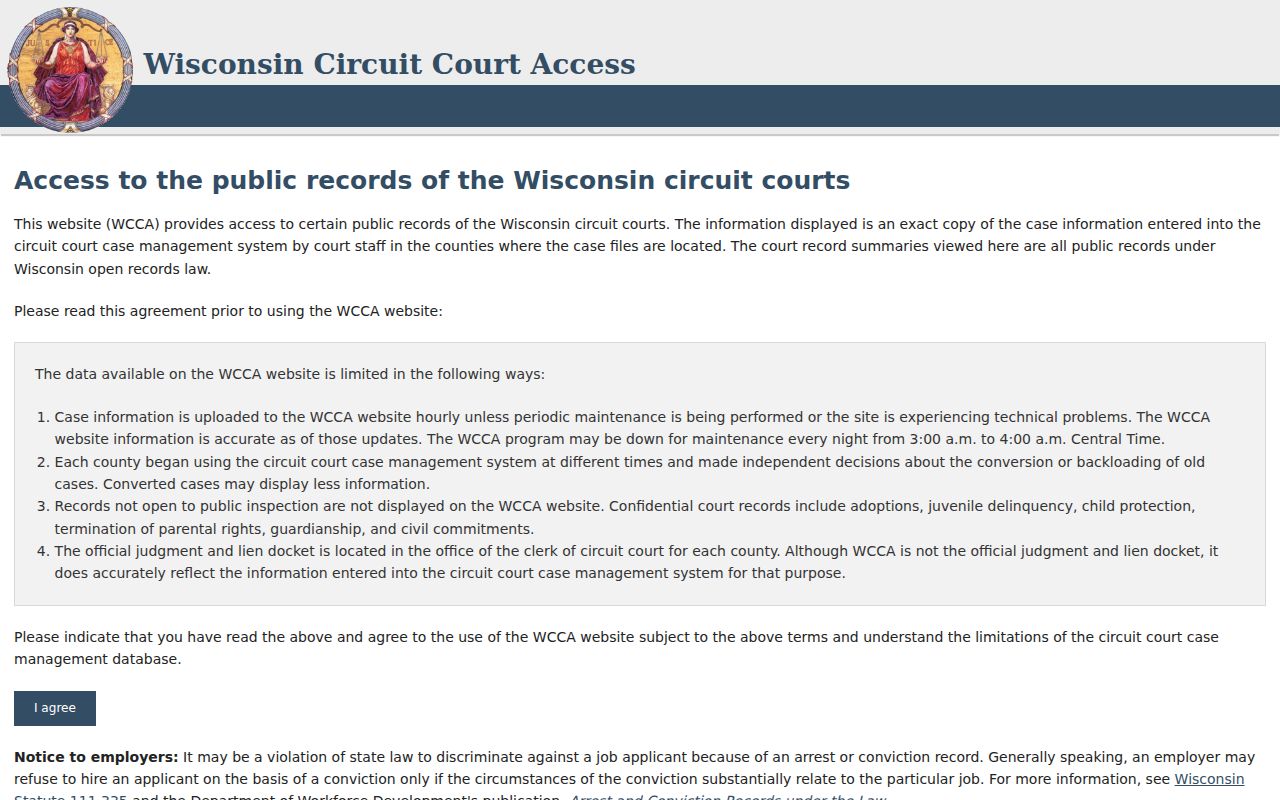
The screen is an index doorway. The court file remains the stronger source when the wording of an order or pleading matters.
Resolve Kenosha Resident Namesakes
A common name can join unrelated Kenosha records. Normalize the name before searching: note the exact spelling, suffix, middle initial, maiden or prior name, and any organization name. Then write down the municipality and date tied to each result. A WCCA party match from years ago cannot be treated as current Kenosha residence. A registered-office address in a DFI filing cannot be treated as a person's home.
Use at least two matching traits from independent sources. Name plus address plus a close date is stronger than a name alone. A parcel address may be checked against the deed, while a historic directory entry may be checked against a newspaper, cemetery record, probate file, or vital index. Note a negative result as “not located” with the search date and system limits. Sealing, name variation, an inactive record, or a restricted category may explain the absence.
Note: Keep situs, mailing, postal-city, and legal-municipality fields separate because each describes a different relationship to Kenosha.
Confirm Kenosha Voter Details
MyVote Wisconsin supports a voter checking registration information by first name, last name, and birth date. Its separate address mode asks for street address, an optional unit, city, and ZIP. The result can show registration information, elections participated in, elected officials, address-update tools, absentee request functions, and ballot tracking. It never reveals how a ballot was marked.
If a name does not match, MyVote advises trying the form printed on the Wisconsin driver license or ID, removing spaces or special characters, and testing first-name variants. Exact unit, city, and ZIP formatting matters in address mode. Public voter-data extracts are a different channel. Badger Voters offers paid CSV files with jurisdiction and status filters, while confidential electors and protected voters are excluded. The file omits birth dates, driver-license numbers, Social Security numbers, party preference, demographics, and ballot choices.
The MyVote search form makes the difference between a personal voter check and a broad resident directory clear.
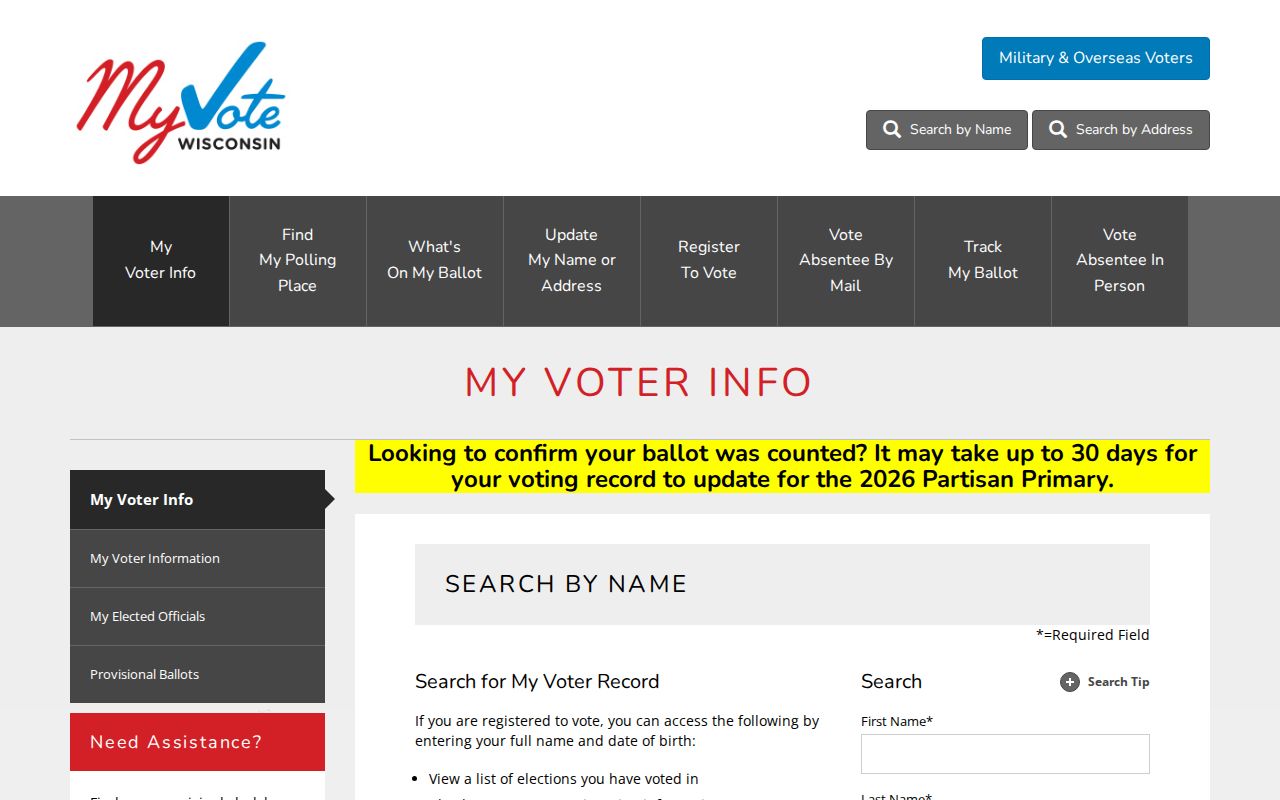
Use the displayed voter functions for their stated purpose and do not turn a nonmatch into a claim that someone does not live in Kenosha.
Verify a Kenosha Resident Match
A defensible match review records how each fact was found. Begin with the least intrusive source that can answer the question. Stop when enough evidence exists. The workflow below anchors a name to a dated source and avoids treating a loose internet match as proof.
- Normalize the name. Record spelling, middle initial, suffix, prior name, and likely municipality before opening an index.
- Test the known address. Use Property Inquiry or GIS for a parcel, or MyVote only in its proper voter-check context.
- Read the date. Keep record date, filing date, event date, and access date as separate fields.
- Cross-check the source class. Pair parcel with deed, court summary with clerk file, or directory with newspaper or vital evidence.
- Cite the custodian. Save the case, parcel, document, directory page, or certificate reference needed to request the underlying record.
- Docket
- The dated list of events and filings in a court case.
- Index
- A finding tool that points to a record but may not reproduce it.
- Image
- A scan or digital copy of the record itself.
- Certified copy
- A custodian-issued copy formally attested as a true copy.
This method also keeps time honest. A current tax card, an old court filing, and a historical directory can all be accurate, yet describe different years.
Kenosha Vital Record Lookup
The Kenosha County Register of Deeds vital-record service is the local route for eligible Wisconsin birth, death, marriage, divorce, and tribal marriage or divorce copies within its stated issuance periods. Statewide mail, online, and phone ordering is described by Wisconsin Vital Records. Applications ask for the record type, names, event date and place, requester information, relationship or direct and tangible interest when required, ID, copy type, payment, and delivery information.
The first copy costs $20 and each additional copy of the same record in the order costs $3. State online orders are described as taking about five business days, while mail generally takes about ten business days plus delivery time. VitalChek adds a processing fee. These are request routes, not an open name search. Wisconsin Stat. §§69.20 and 69.21 control disclosure and copy eligibility.
The county vital-record instructions show the application and eligibility path that follows an index-level resident search.
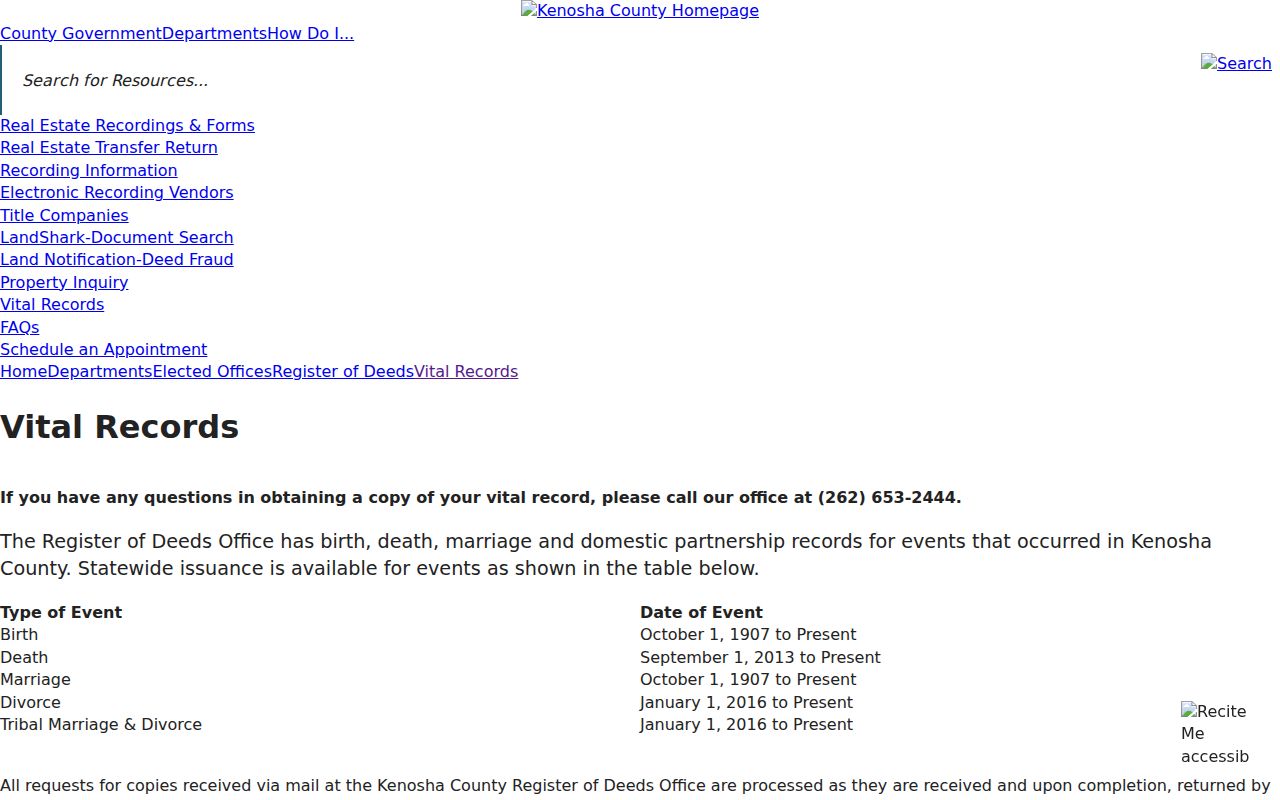
A certificate can establish an event. It should not be used as proof of someone's present address.
Trace Kenosha Residents Historically
Modern portals are weak tools for an older Kenosha resident lookup. UW–Parkside holds a County Court Index for 1850–1970 with party names, case numbers, and document locations, though Volume B is missing. Probate case files extend from 1850–1985 with changing paper, microfilm, and index access. A missing index result should be checked against appearance dockets, probate material, newspapers, or the clerk rather than treated as a final answer.
The Kenosha History Center lists local newspapers from 1845–1945, obituaries from 1960 to the present, city directories from 1858–2000, family histories, cemetery lists, maps, and plat books. Access is by appointment. Kenosha Public Library adds newspaper databases, local yearbooks, oral histories, and scans. When the goal is a full historical household trail, the Kenosha city directory collections provide the dated address layer without turning an old occupant into a present resident.
Check Kenosha Public Credentials
Wisconsin DSPS License Verification accepts a name or credential number. Results may show name, credential number, profession, location, issue date, and expiration date. The system covers more than 240 credential types. Use those fields to verify the public credential and its dates, not to infer a private address or a full personal history.
A business connection belongs in the Wisconsin DFI Corporate Records Search. Search by legal entity name, a name fragment, or DFI Entity ID. Results can include legal name, entity type, effective date, status, registered agent, registered office, principal office, and filing history. DFI does not provide a complete universe of sole proprietors or trade names, and a registered office is not proof that an individual lives there.
Note: Treat a public credential or entity filing as a dated professional or organizational fact, not as a broad resident profile.
Request Missing Kenosha Records
Some Kenosha records have no unrestricted name portal. Municipal citations and proceedings use the Kenosha Municipal Court public-record request form or the court office at 625 52nd Street, Room 97, phone 262-653-4220, and municipalcourt@kenosha.org. Circuit documents are requested from the Clerk of Circuit Court at 912 56th Street, phone 262-653-2664, during listed weekday hours of 8:00 a.m. to 5:00 p.m. Historical files may require an archive appointment.
Wisconsin Public Records Law, Wis. Stat. §§19.31–19.39, supports requests to the office that keeps the record. Give a narrow record type, date range, case number, parcel, or address. A custodian may redact fields, ask for clarification, estimate fees, or deny access under a statute or balancing test. For an incorrect WCCA entry, contact the clerk; court forms also exist for qualifying mistaken-identity and address-removal requests.
Kenosha Resident Lookup Limits
Public does not mean complete. Sealed, juvenile, adoption, and other restricted court matters may not appear. WCCA redacts sensitive identifiers and protected victim, witness, and juror information. Vital certificates have record-specific eligibility rules. Wisconsin Safe at Home provides a substitute address and mail forwarding for eligible people facing safety risks. Confidential-elector status removes an actual address from public voter views and excludes the record from Badger Voters.
A missing result can be a safety measure. Never try to rebuild or publish a protected address from other sources. Corrections also belong with the custodian: the clerk for court data, the election office for voter data, the Register of Deeds or DHS for vital records, and the filing agency for credential or entity data. Keep only the minimum factual field needed to distinguish the record.
Lawful use. Use a Kenosha resident lookup only for lawful personal research. Never use public details to stalk, harass, threaten, or expose a protected person.