
Kenosha City Directory Years
The UW-Parkside collection identifies commercially published Kenosha city directories from the mid-nineteenth century into the twenty-first. Coverage is sparse in the nineteenth century, often every other year in the first half of the twentieth, and nearly annual later. Publisher names vary by volume, so cite the title page rather than assigning one publisher to the whole run.
| Collection | Years | Where Held | Access |
|---|---|---|---|
| Early city volumes | 1858; 1875 partial | UW-Parkside collection | Collection page and archive confirmation |
| Selected early modern runs | 1903, 1904, 1904-05, 1906, 1908-1920 selected | UW-Parkside | Institutional directory holdings |
| Odd-year series | 1921-1947 odd years | UW-Parkside and local archives | Consult volume; use renumbering crosswalk |
| Postwar series | 1950, 1952, 1954-56 | UW-Parkside and local collections | In person or as repository permits |
| Annual series | 1958-1993 | UW-Parkside; History Center overlap | Repository access |
| Recent historical series | 1995-2007 except 2004 | UW-Parkside | Repository access; explicit gap |
A year absent from that list is a collection or publication gap, not proof that a person left Kenosha. Record the nearest edition checked on each side of the gap. The official page does not establish a single publisher or identical entry format for all years.
The same year may survive in more than one local repository, and one copy may be clearer or more complete. Compare title pages and pagination before assuming two scans represent different editions.
The UW-Parkside Kenosha directory collection presents the authoritative year list.
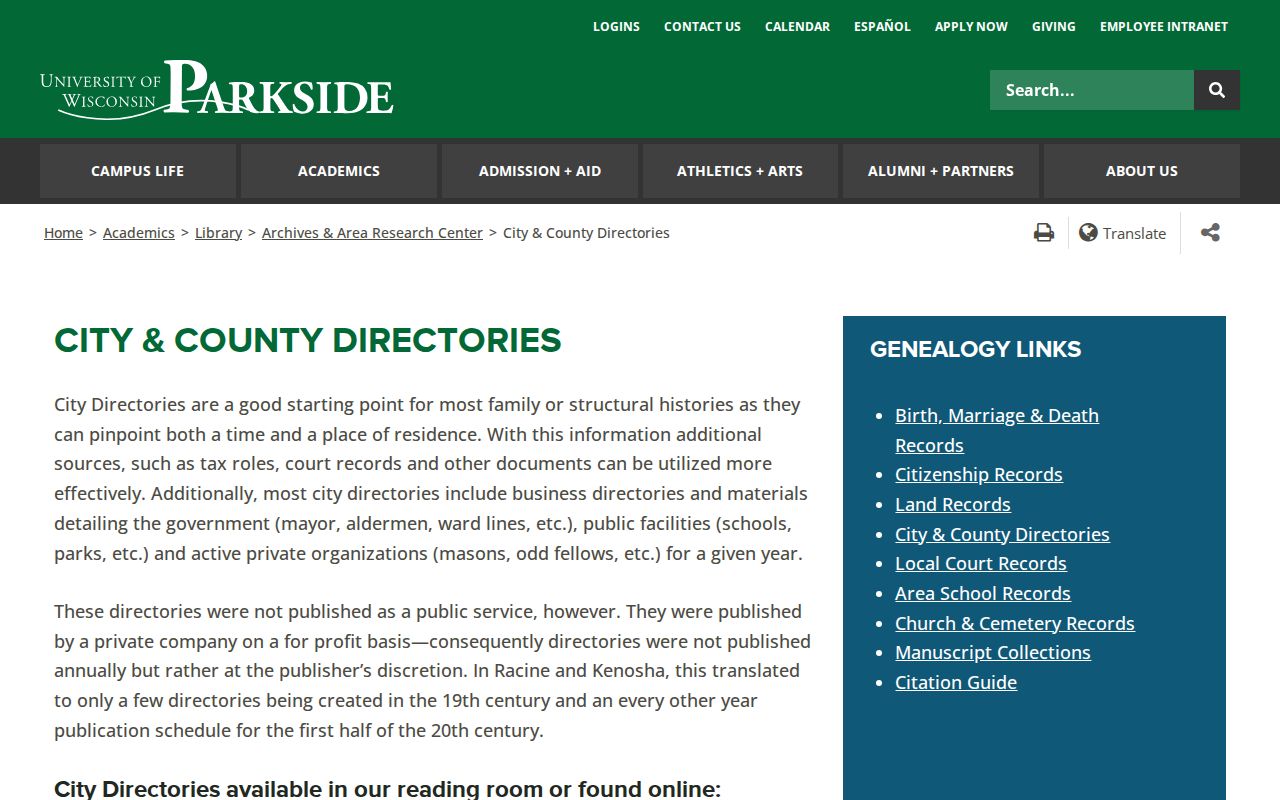
The collection screen is the starting inventory. Confirm the title page, edition, and page format inside the volume used.
Handle Kenosha Directory Gaps
The run changes sharply by era. The early city shelf has only an 1858 volume and a partial 1875 item. Selected editions appear from 1903 through 1920. The 1921-1947 sequence is every odd year, while 1958-1993 is annual. The 1995-2007 run is annual except for 2004. This pattern makes the date of a negative search as important as the name searched.
When a target vanishes, test the prior and next available editions. Search initials, a spouse's name, business listings, and the street section. Then use a newspaper, census year, deed, or obituary as independent evidence. A city directory was commercially compiled, not a complete government count.
Note: Write “not found in the checked edition,” never “not in Kenosha,” when a directory search returns no matching entry.
Read a Kenosha Directory Entry
Entry fields change by edition. Capture only what appears on the page. A useful inventory includes edition and year, page, name exactly as printed, address, street number and name, occupation or business line, telephone when present, classification marks, neighboring entries, and whether the result came from an alphabetical, street, business, or government section.
| Printed name | Copy spelling, initials, and order exactly |
|---|---|
| Address | Preserve the printed house number and street form |
| Business or occupation | Record the line only when the edition includes it |
| Telephone | A later-volume field that may identify a subscriber |
| Section and neighbors | Note alphabetical, street, business, or government context |
- Criss-cross directory
- A street-order section used to move from an address to a printed name or firm.
- Householder index
- An address-oriented list of people designated by the publisher as household contacts.
- Abbreviation key
- The volume's own explanation of short forms and symbols. Save it before interpreting an entry.
Never import meanings from another year without checking that edition's key. A city directory entry may describe an occupant, subscriber, business, or public office. It is not a deed and should not be labeled as ownership proof.
Photograph the title page and abbreviation key before the entry page. Those two frames preserve the edition and explain the publisher's shorthand when the note is reviewed years later.
Reverse Kenosha City Directories
A reverse search begins with the street rather than a surname. Find the address in the street section, copy the listed name or firm, and inspect nearby entries. The method is especially useful when a family name is unknown or spelled several ways. It can also rebuild a small stretch of a historic block.
Kenosha's digitized 1927 New Street Numbering Section is more than a street list. It aligns old and new numbers and identifies Third Avenue as formerly Durkee Avenue. Printed examples pair new and old house numbers with names. Treat those names as historical entries from that source, not as current residents.
For present-day address-keyed parcel and deed records, use the Kenosha street directory workflow. The historical shelf answers a different question: what one commercial edition printed at a stated time.
Research Kenosha Directories by Appointment
The Kenosha History Center archives combine city directories from 1858-2000 with bound newspapers from 1845-1945, obituaries from 1960 forward, maps and atlases from 1835-1985, plat maps from 1858-1934, cemetery lists, family histories, photographs, manuscripts, and industrial collections. This mix lets one directory result be tested against several forms of local evidence.
Archive use is by appointment. Call 262-654-5770 extension 4 or email archives@kenoshahistorycenter.org. A useful request names the person or business, printed address, approximate year, and record groups needed. Asking for one date range and one task gives staff more to work with than a broad request to find someone.
The History Center archive page outlines this collection and its appointment route.
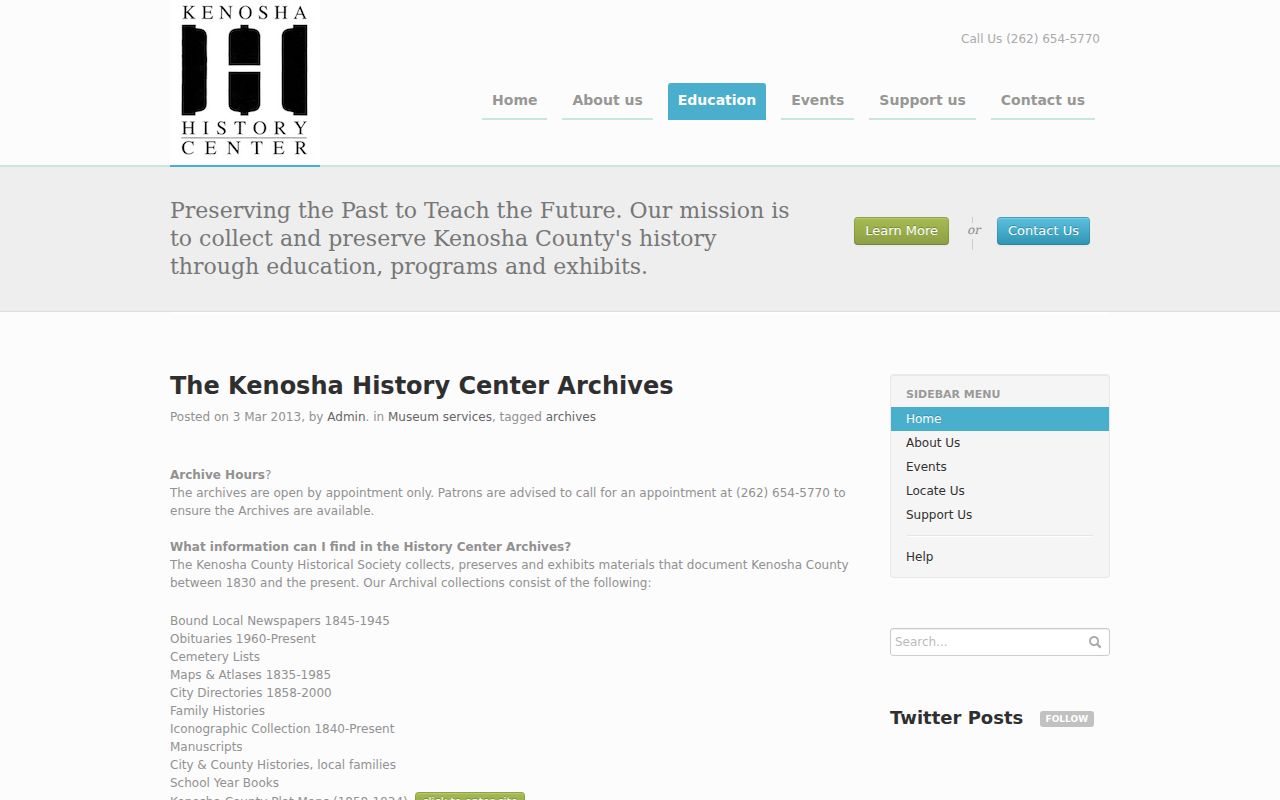
The archive combines directories with place-based evidence, but no single repository should be treated as complete.
Extend Kenosha Directory Clues
Kenosha Public Library genealogy and local history resources add newspapers, yearbooks, oral histories, local images, and licensed genealogy databases. Ancestry Library Edition is in-library only, while HeritageQuest is available both remotely and in the library. The local digital archive includes Western Kenosha historical documents and yearbooks.
KPL's newspaper trail reaches from June 19, 1895 through September 2020 for the Kenosha News archive described by the library. Wisconsin residents can request a scan of a specific page by email. Listed scanning or copying at several branches is $0.25 per page. Supply a date and page whenever possible.
The KPL local-history resource screen shows the mix of database and collection routes.

These sources can confirm a school, business, family event, or address change that the directory alone leaves unclear.
Pair Kenosha Directories With Maps
The earliest listed Kenosha city directory and the History Center's earliest listed county plat material both date to 1858. Used together, they can link a printed city snapshot with land geometry, while each source keeps its own role. Later research can add the verified 1918 Sanborn collection, which has 64 sheets showing intersections, building footprints, uses, and nearby features.
Census schedules and directories also complement each other. A federal census is a ten-year household enumeration. A directory is a commercial annual or biannual snapshot with selective name, address, business, and phone data. Use directory years between census dates to trace moves, then return to the census for household structure.
Church and cemetery records can close a family trail. UW-Parkside lists First Congregational Church records for 1850-1880, Methodist collections spanning 1854-1979, and Unitarian Universalist Kenosha/Racine records for 1842-1995. Active parish records may remain with the parish.
Kenosha Directory Shelf Timeline
The shelf reflects both local growth and changes in publishing. Kenosha County separated from Racine County in 1850, which means earlier names may belong in Racine or territorial records. The listed directory run then becomes denser as the county's population and record systems expand.
| 1850 | Kenosha County separates from Racine County; pre-1850 searches may need the older jurisdiction. |
|---|---|
| 1858 | Earliest Kenosha directory and plat-map material listed in the local collections. |
| 1921-1947 | Odd-year directory sequence; the 1927 crosswalk resolves the city renumbering. |
| 1958-1993 | Annual run creates a dense address and business trail. |
| 1995-2007 | Annual editions continue except for the documented 2004 gap. |
The county population rose from 10,734 in 1850 to 166,426 in 2010. That change helps explain why modern historical runs tend to yield more entries, but population totals do not measure directory completeness.
Trace Family Through Kenosha Directories
A family trail is strongest when each city directory citation can be reproduced. Save a scan or careful transcription with the volume title, year, repository, page, printed name, address, section, and symbols. Follow the same name both forward and backward, and keep conflicts instead of smoothing them away.
- Search the alphabetical section in the closest available year. Test initials, spelling variants, and another known household name.
- Follow the printed name across adjacent editions. Record every address change, occupation or business line, and telephone when shown.
- Turn to the street section. Capture the target address and nearby entries, then apply the 1927 crosswalk when the street or number changed.
- Pair the directory sequence with the closest census, newspaper item, plat, Sanborn sheet, church register, or cemetery record.
- Use a deed only for ownership. A directory occupant, subscriber, boarder, or business name does not by itself establish title.
If the name disappears, search the next available newspaper and obituary period, check nearby family members, and look for a move in the reverse section. Mark the result as unresolved unless another record explains it. Absence can reflect a skipped publication, an unlisted person, a spelling change, death, or relocation.